

Quick Answer
An airless pump is a dispensing system that uses vacuum pressure to push cosmetic products upward without relying on a dip tube. It is commonly used for skincare products such as serums, creams, and lotions where reduced air exposure and controlled dispensing are important.
Key Facts About Airless Pumps
- Airless pumps use a vacuum-based dispensing system
- They do not require a traditional dip tube
- They are commonly used for skincare, serum, cream, and cosmetic packaging
- They can help reduce air exposure in many formulations
- They are often selected for products that need controlled dispensing and premium packaging presentation
Introduction
If you are developing skincare or cosmetic packaging, you may have seen airless pump bottles used for serums, creams, lotions, and premium skincare products.
Compared with traditional lotion pumps, airless pumps use a different dispensing structure. Instead of drawing product through a dip tube, they use vacuum pressure to push the product upward from inside the container.
In this guide, you will learn:
- What an airless pump is
- How an airless pump works
- Main components of an airless pump
- Common applications
- Advantages and limitations
- How to know whether your product needs an airless pump
👉 Related reading: What Is a Cosmetic Pump?
What Is an Airless Pump?
An airless pump is a cosmetic dispensing system designed to release product through vacuum pressure. Unlike a standard lotion pump, it does not use a dip tube to pull liquid from the bottom of the bottle.
Instead, many airless pump systems use an internal piston or moving base. When the pump is pressed, the system creates pressure that pushes the product upward and dispenses it through the actuator.
Airless pumps are commonly used in:
- Facial serums
- Skincare creams
- Lotions
- Sunscreen
- Anti-aging products
- Cosmetic emulsions
In many cosmetic packaging applications, airless pumps are selected when brands want reduced air exposure, cleaner dispensing, and a more controlled user experience.
How Does an Airless Pump Work?
An airless pump works through a vacuum-based dispensing mechanism.
Basic Working Process
- The user presses the actuator
- The pump mechanism creates pressure
- The internal piston or base moves upward
- Product is pushed toward the dispensing head
- The product exits through the nozzle
Because the product is pushed upward from inside the container, a traditional dip tube is not required.
This design helps reduce the amount of air entering the package during use, which can be useful for many skincare and cosmetic formulations.
Airless Pump Structure
A typical airless pump system includes several key parts:
- Actuator – the part pressed by the user
- Pump head – controls dispensing movement
- Bottle body – holds the product
- Internal piston or moving base – pushes product upward
- Sealing system – helps maintain vacuum performance
- Nozzle – releases the product
👉 Image suggestion: insert a diagram here with the file name:
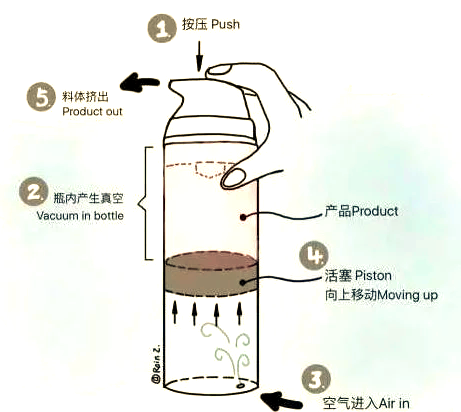
This image can help users quickly understand the difference between an airless pump and a traditional lotion pump.
Airless Pump vs Traditional Lotion Pump
Although both airless pumps and lotion pumps are used for dispensing cosmetic products, their structures are different.
| Feature | Airless Pump | Lotion Pump |
|---|---|---|
| Dispensing system | Vacuum system | Dip tube system |
| Air exposure | Reduced in many designs | Air may enter during use |
| Common applications | Serum, cream, skincare | Shampoo, lotion, liquid soap |
| Packaging positioning | Often used for premium skincare | Commonly used for daily care products |
| Product residue | Can be reduced in some designs | Some residue may remain near the bottle bottom |
👉 Detailed comparison: Airless Pump vs Lotion Pump
Main Applications of Airless Pumps
Airless pumps are widely used in skincare and cosmetic packaging. They are especially common in products where formula protection, clean dispensing, and user experience matter.
1. Skincare Serums
Serums often use airless pumps because they usually require smaller, controlled dispensing amounts.
Airless packaging can help reduce repeated exposure to outside air during daily use, depending on the product formula and packaging structure.
2. Face Creams
Airless pumps are often used for face creams because they allow users to dispense product without dipping fingers into a jar.
This can improve hygiene and make the product easier to use.
3. Sunscreen and Functional Skincare
For sunscreen and functional skincare products, controlled dispensing can improve user convenience.
Airless pumps may be suitable when the product requires cleaner application and consistent output.
4. Anti-Aging Products
Anti-aging skincare products are often packaged in airless pump bottles because brands may want a more premium packaging appearance and reduced air exposure.
Advantages of Airless Pumps
1. Reduced Air Exposure
One of the main reasons brands use airless pumps is to reduce air contact during use.
This may be useful for formulations that are sensitive to oxidation or need better protection from repeated exposure.
2. Controlled Dispensing
Airless pumps can provide relatively controlled output when properly matched with the formulation.
This helps users dispense a suitable amount of product each time.
3. Improved Hygiene
Compared with jars, airless pumps reduce the need for direct finger contact with the product.
This can help improve the user experience for skincare products.
4. Reduced Product Residue in Some Designs
Because the piston pushes product upward, some airless pump designs can help reduce leftover product inside the container.
Actual performance depends on bottle structure, formula viscosity, and pump design.
5. Premium Packaging Appearance
Airless pump bottles are often used in skincare products positioned as premium or functional.
The clean dispensing experience can support a more refined brand presentation.
Limitations of Airless Pumps
Airless pumps are useful in many applications, but they are not suitable for every product.
1. Higher Packaging Cost
Compared with traditional lotion pumps, airless pumps usually have a more complex structure.
This often makes them more expensive than standard lotion pump packaging.
2. Formula Compatibility Still Matters
Not every formula works well with every airless pump system.
Viscosity, texture, and ingredient composition should be tested before production.
3. Not Always Necessary
For products such as shampoo, liquid soap, or basic body lotion, a traditional lotion pump may be more cost-effective in many cases.
When Should You Use an Airless Pump?
You may consider using an airless pump when:
- Your product is a serum, cream, or skincare lotion
- The formula is sensitive to air exposure
- You want cleaner dispensing than a jar
- You need controlled dosage
- Your product has a premium positioning
- You want to reduce product residue in certain packaging designs
However, the final choice should depend on product viscosity, packaging budget, and compatibility testing.
When a Lotion Pump May Be More Suitable
A lotion pump may be more suitable when:
- Your product is shampoo, conditioner, or liquid soap
- Cost control is important
- The formula is not highly sensitive to air exposure
- You need a larger output per press
- The product is used frequently in larger amounts
👉 Related reading: Lotion Pump Size Guide
How to Choose an Airless Pump
Step 1: Check Product Viscosity
Different airless pump systems are suitable for different viscosities.
A formula that is too thick or too thin may affect dispensing performance.
Step 2: Decide the Required Dosage
Skincare products often need smaller output per press.
Before choosing a pump, you should confirm the desired dosage and user application scenario.
Step 3: Test Formula Compatibility
Testing with the actual formula is important.
In practical packaging projects, some dispensing problems happen because the pump and formula are not properly matched.
Step 4: Consider Bottle Capacity
Common airless pump bottles are used for small to medium skincare packaging.
The right capacity depends on product category, retail positioning, and user consumption habits.
Step 5: Evaluate Customization Needs
Airless pump packaging can often be customized by:
- Color
- Bottle shape
- Surface finish
- Logo printing
- Pump output
- Cap or actuator design
Common Problems with Airless Pumps
1. Product Does Not Dispense at First
Some airless pumps need several presses before the product comes out.
This is usually related to the priming process.
2. Pump Output Is Inconsistent
Possible reasons include:
- Formula viscosity mismatch
- Air leakage
- Pump structure mismatch
- Incorrect filling process
3. Product Feels Hard to Pump
This may happen when the formulation is too thick for the selected pump structure.
Compatibility testing can help identify this issue before production.
4. Leakage During Shipping
Leakage can be caused by sealing problems, poor compatibility, or incorrect assembly.
Packaging should be tested under typical transportation and storage conditions.
Case Example
Problem: A skincare brand wanted to package a medium-viscosity serum in a cleaner and more premium dispensing format.
Method: The packaging was tested with an airless pump bottle, and the dosage output was adjusted to match the product texture.
Result: Under normal usage conditions, the product dispensed more consistently, and the packaging presentation matched the brand’s skincare positioning.
Expert Tip
Based on practical packaging experience, airless pump selection should not be based only on appearance. The most important step is testing the pump with the actual formula.
A beautiful airless bottle may still perform poorly if the formula viscosity, pump output, and sealing structure are not properly matched.
FAQ
What is an airless pump used for?
An airless pump is commonly used for skincare products such as serums, creams, lotions, sunscreen, and cosmetic emulsions.
How does an airless pump work?
An airless pump uses vacuum pressure to push product upward from inside the container. It does not rely on a traditional dip tube.
Is an airless pump better than a lotion pump?
They are designed for different applications. Airless pumps are often suitable for skincare products that need reduced air exposure, while lotion pumps are commonly used for shampoo, body lotion, and liquid soap.
Does an airless pump bottle need a dip tube?
No. Most airless pump systems do not use a traditional dip tube. They use an internal piston or vacuum structure to push the product upward.
Can airless pumps be used for thick creams?
They can be used for some creams, but compatibility depends on the formula viscosity and pump structure. Testing is recommended before production.
Why is my airless pump not dispensing?
Common reasons include incomplete priming, air leakage, formula mismatch, or pump structure mismatch.
Are airless pump bottles refillable?
Some airless pump bottles may be designed for refill use, but many standard airless systems are not intended for repeated refilling. This depends on the packaging design.
Conclusion
An airless pump is a vacuum-based dispensing system commonly used in skincare and cosmetic packaging. It can help reduce air exposure, improve hygiene, and provide controlled dispensing in many applications.
However, airless pumps are not suitable for every product. The right choice depends on formula viscosity, dosage requirements, packaging budget, and compatibility testing.
For skincare brands, airless pumps can be a suitable option when product protection, user experience, and premium packaging presentation are important.
Need Help Choosing an Airless Pump?
If you are developing skincare or cosmetic packaging, we can help you evaluate:
- Airless pump type
- Bottle capacity
- Dosage output
- Formula compatibility
- Custom packaging options