

Quick Answer
A foam pump mixes liquid with air to create foam, while a spray pump atomizes liquid into mist or spray. Foam pumps are commonly used for facial cleansers, hand wash, and foaming products, while spray pumps are usually used for toner, perfume, body mist, and low-viscosity liquid products.
Key Facts About Foam Pumps and Spray Pumps
- Foam pumps create foam by mixing liquid with air
- Spray pumps turn liquid into mist or spray through a nozzle
- Foam pumps require formulas that can generate foam
- Spray pumps work best with low-viscosity liquids
- Foam pumps are often used for cleansers and hand wash
- Spray pumps are commonly used for toner, perfume, and mist products
Introduction
Foam pumps and spray pumps are both widely used in cosmetic and personal care packaging, but they are designed for very different products.
For brands, packaging buyers, and product developers, choosing the wrong pump can lead to poor user experience, unstable dispensing, clogging, or formula mismatch. A foam pump is not simply a different style of spray pump. It has a different internal structure, different working principle, and different formula requirements.
In this guide, we will explain the key differences between foam pumps and spray pumps, how each one works, where they are used, and how to choose the right option for your product.
Related reading: Types of Cosmetic Pumps
What Is a Foam Pump?
A foam pump is a dispensing pump designed to mix liquid with air and dispense the product as foam.
Unlike a regular lotion pump that dispenses liquid directly, a foam pump contains an air-mixing structure. When pressed, the pump draws liquid and air together, creating foam before the product exits the nozzle.
Common Uses of Foam Pumps
Foam pumps are commonly used for:
- Facial cleanser
- Foaming hand wash
- Body wash
- Baby wash
- Foam sanitizer
- Cleansing mousse
Main Features of Foam Pumps
- Produces foam without aerosol gas
- Improves product spreading
- Gives a softer user experience
- Often reduces the amount of product used per application
- Requires a compatible foaming formula
Foam pumps are especially suitable for products where texture and user experience are important.
What Is a Spray Pump?
A spray pump is a dispensing pump designed to break liquid into small droplets and release it as a mist or spray.
Instead of creating foam, a spray pump uses pressure and nozzle design to atomize liquid. The spray effect depends on the liquid viscosity, nozzle structure, and pump output.
Common Uses of Spray Pumps
Spray pumps are commonly used for:
- Facial toner
- Perfume
- Body mist
- Hair spray
- Room spray
- Alcohol spray
- Low-viscosity skincare liquids
Main Features of Spray Pumps
- Creates fine mist or spray
- Suitable for low-viscosity liquids
- Provides even product distribution
- Easy to use for facial and body applications
- No foam generation required
Spray pumps are often chosen when the product needs to be applied evenly over a surface.
Foam Pump vs Spray Pump: Key Differences
| Feature | Foam Pump | Spray Pump |
|---|---|---|
| Dispensing Form | Foam | Mist or spray |
| Working Principle | Mixes liquid with air | Atomizes liquid through nozzle |
| Best For | Cleansers, hand wash, foam products | Toner, perfume, mist, spray liquids |
| Formula Requirement | Must be able to foam | Must be low-viscosity |
| Texture | Soft foam | Fine droplets |
| User Experience | Gentle and creamy | Light and refreshing |
| Common Product Type | Wash-off products | Leave-on or spray-on products |
| Risk if Mismatched | No foam or unstable foam | Clogging or uneven spray |
How Does a Foam Pump Work?
A foam pump works by combining liquid and air inside the pump mechanism.
Basic Working Process
- The user presses the pump head
- Liquid is drawn from the bottle
- Air enters the pump chamber
- Liquid and air mix through an internal mesh or foaming structure
- Foam is dispensed through the nozzle
The quality of foam depends on both pump structure and product formula.
If the formula is too thick or does not contain suitable foaming ingredients, the pump may not produce stable foam.
How Does a Spray Pump Work?
A spray pump works by pushing liquid through a small nozzle under pressure.
Basic Working Process
- The user presses the actuator
- Liquid is pushed upward through the pump chamber
- The liquid passes through a fine nozzle
- The nozzle breaks the liquid into small droplets
- Mist or spray is released
The spray pattern depends on nozzle design, liquid viscosity, and pump quality.
If the liquid is too thick, the spray may become uneven, weak, or blocked.
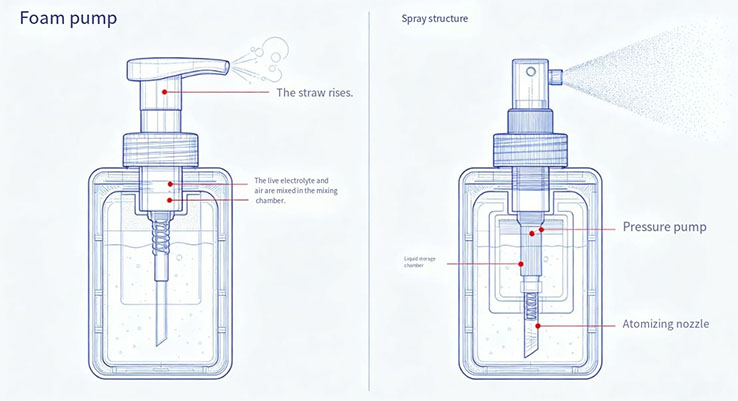
Foam Pump Structure vs Spray Pump Structure
A foam pump and a spray pump may look similar from the outside, but their internal designs are different.
Foam Pump Structure
A foam pump usually includes:
- Actuator
- Closure
- Air chamber
- Liquid chamber
- Foaming mesh
- Dip tube
Spray Pump Structure
A spray pump usually includes:
- Actuator
- Nozzle
- Pump chamber
- Spring and piston
- Dip tube
- Closure
Application Comparison
| Product Type | Better Choice | Reason |
|---|---|---|
| Facial cleanser | Foam pump | Creates soft foam for cleansing |
| Foaming hand wash | Foam pump | Improves washing experience |
| Baby wash | Foam pump | Gentle foam texture |
| Toner | Spray pump | Fine mist application |
| Perfume | Spray pump | Atomized fragrance delivery |
| Body mist | Spray pump | Even coverage |
| Alcohol spray | Spray pump | Fast and wide application |
| Thick lotion | Neither is ideal | Lotion pump may be better |
For wash-off cleansing products, foam pumps are often more suitable. For lightweight liquid products, spray pumps are usually a better choice.
Formula Compatibility
Pump selection should always consider product formula.
Foam Pump Formula Requirements
Foam pumps generally require formulas that:
- Have proper foaming ability
- Are not too thick
- Can mix well with air
- Do not clog the foaming mesh
If the formula cannot generate foam, changing the pump alone will not solve the problem.
Spray Pump Formula Requirements
Spray pumps generally work best with formulas that:
- Have low viscosity
- Flow smoothly through the nozzle
- Do not contain large particles
- Do not clog the spray channel
Products with high viscosity or suspended particles may not spray evenly.
User Experience Comparison
Foam Pump User Experience
Foam pumps provide a soft and rich texture. This makes them suitable for cleansing products where touch and comfort matter.
Common user experience benefits include:
- Softer application
- Easier spreading
- Less dripping
- More premium cleansing feel
Spray Pump User Experience
Spray pumps provide lightweight and even application. This makes them suitable for products that need to cover skin, hair, or surfaces quickly.
Common user experience benefits include:
- Even distribution
- Fast application
- Refreshing feel
- Easy use for liquid products
Cost and Packaging Considerations
In general, foam pumps may have a more complex internal structure than simple spray pumps. This can affect cost, bottle matching, and formula testing requirements.
Foam Pump Considerations
- Requires formula compatibility testing
- May need more space due to pump structure
- Suitable for brands emphasizing texture and cleansing experience
Spray Pump Considerations
- Requires nozzle performance testing
- More sensitive to viscosity and particles
- Suitable for lightweight liquid applications
The best option depends not only on pump price, but also on the product formula, target market, and user expectations.
Common Problems with Foam Pumps
1. No Foam Comes Out
Possible causes:
- Formula does not foam well
- Product viscosity is too high
- Foaming mesh is blocked
- Pump structure does not match the formula
2. Foam Is Too Watery
Possible causes:
- Formula concentration is too low
- Air-liquid mixing ratio is not suitable
- Pump output does not match the formula
3. Pump Feels Hard to Press
Possible causes:
- Formula is too thick
- Internal channel is blocked
- Pump structure is not suitable
Common Problems with Spray Pumps
1. Spray Is Uneven
Possible causes:
- Liquid viscosity is too high
- Nozzle is partially blocked
- Pump output is unstable
2. Spray Pump Clogs
Possible causes:
- Formula contains particles
- Product dries inside the nozzle
- Nozzle channel is too small
3. Spray Is Too Strong or Too Weak
Possible causes:
- Nozzle design mismatch
- Pump output mismatch
- Formula flow issue
How to Choose Between Foam Pump and Spray Pump
Step 1: Check Product Type
If your product is a cleanser or wash-off product, a foam pump may be suitable.
If your product is toner, perfume, mist, or alcohol spray, a spray pump is usually more suitable.
Step 2: Check Product Viscosity
- Low-viscosity liquid → spray pump
- Foaming liquid → foam pump
- Thick lotion → lotion pump may be better
Related reading: How Does a Lotion Pump Work?
Step 3: Consider User Experience
Choose foam pump if you want:
- Soft foam texture
- Cleansing experience
- Gentle application
Choose spray pump if you want:
- Fine mist
- Even coverage
- Quick application
Step 4: Test the Formula
Testing is important because the same pump may perform differently with different formulas.
Before mass production, test:
- Foam quality
- Spray pattern
- Output consistency
- Leakage
- Clogging risk
- Pressing feel
Step 5: Match Bottle and Closure Size
Pump type must also match bottle neck size and packaging design.
Common closure specifications may vary depending on product type and supplier. Always confirm compatibility between pump, bottle, and formula before production.
Foam Pump vs Spray Pump: Which One Is Better?
Neither foam pump nor spray pump is universally better. The right choice depends on the product.
Choose a Foam Pump If:
- Your product is a cleanser
- Your formula can generate foam
- You want a soft washing experience
- Your product is used with water
- Texture is important for your brand
Choose a Spray Pump If:
- Your product is a low-viscosity liquid
- You need mist or spray application
- Your product is toner, perfume, or body mist
- Even surface coverage is important
- You want fast and convenient application
In practical packaging selection, the best pump is the one that matches the formula and usage scenario.
Foam Pump vs Spray Pump vs Lotion Pump
Sometimes, buyers compare foam pumps and spray pumps, but the real answer may be a lotion pump.
| Pump Type | Best For | Not Ideal For |
|---|---|---|
| Foam Pump | Foaming cleansers, hand wash | Non-foaming formulas |
| Spray Pump | Toner, perfume, mist | Thick lotions |
| Lotion Pump | Shampoo, body lotion, soap | Fine mist or foam applications |
If your product is thick lotion, shampoo, or conditioner, a lotion pump may be more suitable than both foam and spray pumps.
Related reading: Lotion Pump Size Guide
Expert Tip
Based on practical packaging experience, pump selection should not be made by appearance alone.
Foam pumps, spray pumps, and lotion pumps may look similar from the outside, but their internal structures and formula requirements are different. For new product development, testing the pump with the actual formula is one of the most important steps before confirming bulk production.
FAQ
What is the difference between a foam pump and a spray pump?
A foam pump mixes liquid with air to create foam, while a spray pump atomizes liquid into mist or spray.
Can I use a foam pump for any liquid soap?
Not always. The formula must be suitable for foaming. Some liquid soaps may be too thick or may not generate stable foam.
Can a spray pump be used for thick lotion?
Usually not. Thick lotions may clog the nozzle or fail to spray evenly. A lotion pump is usually more suitable for thicker products.
What products are suitable for foam pumps?
Foam pumps are commonly used for facial cleansers, foaming hand wash, baby wash, body wash, and foam sanitizers.
What products are suitable for spray pumps?
Spray pumps are commonly used for toner, perfume, body mist, hair spray, room spray, and other low-viscosity liquids.
Why is my foam pump not making foam?
Possible reasons include formula incompatibility, high viscosity, blocked foaming mesh, or pump structure mismatch.
Why is my spray pump not spraying properly?
Possible reasons include nozzle blockage, high viscosity, particles in the formula, or poor pump-formula compatibility.
Which is better, foam pump or spray pump?
It depends on the product. Foam pumps are better for foaming cleansers, while spray pumps are better for lightweight liquids that need mist or spray application.
Conclusion
Foam pumps and spray pumps are designed for different dispensing needs. A foam pump creates foam by mixing liquid with air, making it suitable for facial cleansers, hand wash, and foaming products. A spray pump atomizes liquid into mist or spray, making it suitable for toner, perfume, body mist, and low-viscosity liquids.
The right choice depends on formula viscosity, product type, user experience, and packaging design. Before mass production, testing the actual formula with the selected pump is strongly recommended to avoid issues such as clogging, unstable foam, leakage, or uneven spray.
Need Help Choosing Foam Pumps or Spray Pumps?
If you are developing facial cleanser, hand wash, toner, mist, perfume, or personal care packaging, choosing the right pump can improve product performance and user experience.
We can help you evaluate:
- Foam pump options
- Spray pump options
- Formula compatibility
- Bottle matching
- Output performance
- Custom color and design options